
Electrifi in Action: Enabling Fully 3D-Printed Circularly Polarized RF Antennas
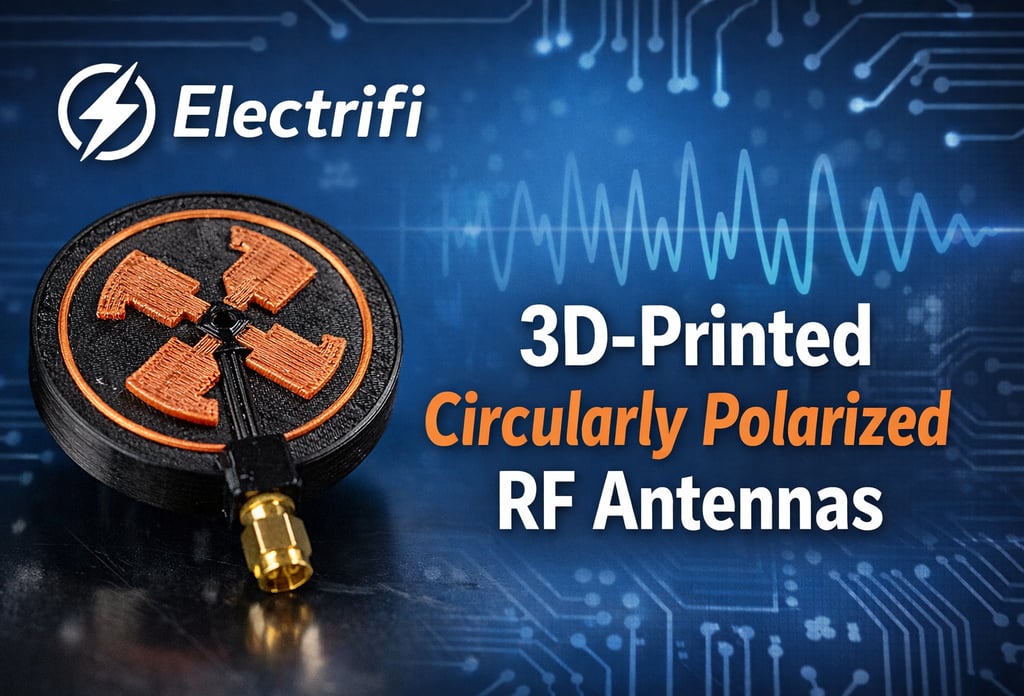
Researchers recently demonstrated fully 3D-printed circularly polarized RF patch antennas fabricated using Electrifi conductive filament and PLA through dual-extrusion FFF printing. This work highlights how conductive additive manufacturing enables antenna geometries and embedded structures that are difficult to realize using traditional PCB fabrication.
ELECTRIFI RESEARCH SPOTLIGHT
3/14/20263 min read
Electrifi in Action: Enabling Fully 3D-Printed Circularly Polarized RF Antennas
One of the most compelling validations of Electrifi’s capabilities comes not from marketing claims, but from peer-reviewed RF research. A recent paper published in IEEE Antennas and Wireless Propagation Letters demonstrates how Electrifi conductive filament can be used to fabricate compact circularly polarized (CP) patch antennas using a dual-extruder fused filament fabrication (FFF) process.
The work shows that conductive additive manufacturing can enable antenna geometries that are extremely difficult—if not impossible—to realize using traditional PCB fabrication or metallization approaches.
This study highlights three important aspects of Electrifi: printability, RF performance tradeoffs, and its significance for microwave antenna design.
1. Printability: Metal–Dielectric Integration in a Single Build
A longstanding challenge in RF additive manufacturing is the integration of metallic and dielectric structures within a single monolithic build. Conventional approaches often rely on:
copper tape
electroplating
post-processing metallization
These additional steps increase fabrication time, introduce alignment challenges, and limit design freedom.
In this research, Electrifi enables a fundamentally different workflow. Using a dual-extruder FFF printer, the researchers directly printed:
PLA as the dielectric substrate
Electrifi conductive filament as the metallic antenna structures
Both materials were deposited layer-by-layer within a single build, forming embedded conductive patches, blind vias, and perturbation features without secondary metallization processes.
Key printing parameters reported in the study include:
Electrifi extrusion temperature ≈ 145 °C
print speed ≈ 15 mm/s
large nozzle diameter and 100 % infill to preserve conductivity
This confirms an important practical point: Electrifi is not only printable—it can be reliably printed on commercial dual-extruder FFF systems when treated as a functional electronic material rather than a commodity filament.
2. Performance: Conductivity in an RF Context
The researchers measured the conductivity of the printed Electrifi structures to be approximately 2,500 S/m across the 0.72–2.5 GHz frequency range.
Compared with bulk copper, this lower conductivity introduces several tradeoffs:
higher conductor loss
reduced radiation efficiency (≈ 55–60 %)
slightly lower antenna gain compared with copper antennas
However, the key result of the work is not that Electrifi matches copper, but that it performs well enough to enable new antenna architectures through additive manufacturing.
Despite the conductivity limitation, the researchers achieved:
compact antenna size (< 0.4 λ₀)
stable circular polarization
good agreement between simulated and measured results
radiation gains of approximately 3.3–3.6 dBic
Importantly, the study shows that the primary limitation is material conductivity rather than geometric accuracy. The printed structures closely matched simulations, demonstrating that Electrifi supports precise and repeatable RF geometries, even in complex 3D forms.
3. Significance: Expanding the RF Design Space
What makes this work particularly important is not incremental performance improvement, but architectural freedom.
Using Electrifi, the researchers implemented:
non-uniform metal blind vias with varying depths
embedded conductive perturbation features enabling circular polarization
fully embedded metal structures inside the dielectric substrate
These geometries are extremely difficult to fabricate using traditional PCB technology or machined copper structures.
In fact, the paper compares Electrifi-based antennas with copper prototypes and notes that while copper provides higher conductivity, the printed structures offer geometric flexibility that conventional fabrication methods struggle to achieve.
In other words: Electrifi enables antenna structures that are difficult to realize with traditional metal fabrication.
This shifts the discussion from “Is Electrifi as conductive as copper?” to more relevant engineering questions:
Can Electrifi enable new RF geometries?
Can it shorten antenna design–build–test cycles?
Can conductive, dielectric, and mechanical functions be integrated in a single print?
The results presented in this research suggest that the answer is yes.
Looking Forward: Higher Conductivity, Same Design Freedom
The authors also point toward future conductive filaments with higher conductivity, noting that antenna performance will improve as material conductivity increases.
This aligns with Multi3D’s ongoing materials development efforts. Under optimized processing conditions, newer Electrifi formulations can reach conductivities approaching 100,000 S/m, further expanding the performance envelope of conductive additive manufacturing.
Final Takeaway
This work demonstrates that Electrifi is not simply a conductive filament—it is a design-enabling RF material.
By combining
practical FFF printability
sufficient RF conductivity
exceptional geometric freedom
Electrifi opens new possibilities for:
fully 3D-printed microwave components
rapid RF prototyping
research-driven antenna innovation
For engineers and researchers, the key insight is:
When geometry and integration matter more than absolute conductivity, Electrifi enables RF structures that traditional manufacturing struggles to achieve.
References
Research Article
Compact Circularly Polarized Patch Antennas Using 3-D Printed Non-Uniform Metal-Dielectric Structure
IEEE Antennas and Wireless Propagation Letters (2026). DOI: 10.1109/LAWP.2026.3655020
IEEE Xplore:
https://ieeexplore.ieee.org/document/11355966
Electrifi Research Spotlight — Episode 1
Watch our video explaining the research and antenna design:
YouTube (full episode)
https://youtu.be/2xrjrNejEiM
Follow Multi3D
Learn more about Electrifi and conductive additive manufacturing:
YouTube
https://www.youtube.com/@multi3d.materials
X (Twitter)
https://x.com/multi3d2025